Nnamdi Azikiwe University (UNIZIK), Awka, has set up a committee to investigate the sexual misconduct allegation involving a female student and a professor, after videos of the incident and the subsequent assault of the lecturer went viral on social media.
The university’s Director of Information and Public Relations, Aloysius Attah, confirmed the development on Monday, saying the investigation had only just commenced.
“It happened on a Saturday, and we know it’s a weekend. Every action about the whole thing is just being activated this morning. A committee has been set up to investigate,” Attah said.
Attah identified lecturer involved in a viral video circulating online as Professor Ifeanyi Sunny Odinye of the Department of Chinese Studies, Faculty of Arts, noting that the university had not established the identity of the female student at the centre of the allegation.
“Every other thing will be followed up. Security agencies are already involved also because there is the assault and the criminal dimension of it and the rest of it,” he said.
Odinye, according to Attah, was receiving treatment at a hospital and had not yet made an official statement about the incident.
“The lecturer involved is at the hospital presently receiving treatment. He has not spoken officially also. But everything is being documented,” he said.
Attah said he had not been fully briefed about the circumstances surrounding the incident because the investigation had only just begun.
“I wasn’t at the scene. I have not even been fully briefed about the whole incident,” he said.
He added that he intended to visit the professor at the hospital to obtain further information.
The controversy erupted after videos circulated widely on social media with claims that a lecturer had sexually harassed a female student.
In one of the videos, a young woman, described in the caption as a student of the university, is seen walking towards the camera while carrying what appeared to be a man’s clothes. Behind her, a naked man is seen moving away from the scene before several male students rush towards him and beat him.
Attah said security agencies had also become involved because the assault on the professor had a criminal dimension.
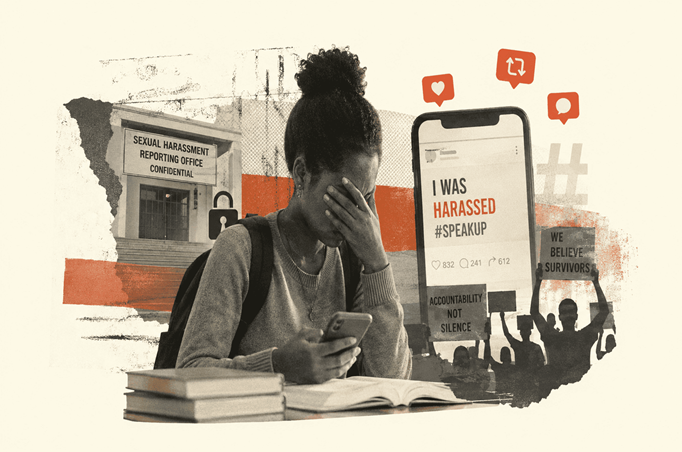
The incident comes against the backdrop of the raising cases of students amplifying cases of sexual harassment on social media.
Executive Lead of Gender Mobile Initiative, Omowumi Ogunrotimi, said the increasing use of social media to disclose sexual harassment allegations could be a warning about students’ confidence in formal accountability systems.
“Students may fear that reporting privately will result in an internal process that nobody outside the institution will see or scrutinize. Social media, by contrast, can create immediate visibility and external pressure. Once an incident becomes public, students may perceive that the institution is more likely to act because there is now reputational accountability,” Ogunrotimi said.
According to Ogunrotimi, the existence of a sexual harassment policy or committee does not automatically mean students consider the system safe or effective.
“A university may have a sexual harassment policy or a committee on paper, but that does not necessarily mean that students experience the system as accessible, safe, confidential, impartial or responsive,” she said.
She identified uncertainty around reporting procedures as one factor that can discourage students from using formal channels.
“If students do not know where to report, what happens after they report, how long the process will take, or whether they will be protected from retaliation, they are less likely to trust the formal pathway,” she said.
UNIZIK said it has channels for students to report complaints and that the Dean of Student Affairs handles students’ welfare-related concerns.
Attah said complaints brought through the university’s reporting channels are referred to the appropriate committees, which consider the issues and make recommendations to management, including recommendations on sanctions where necessary.
The university’s public-facing Student Affairs information also states that the unit handles students’ personal complaints and concerns and is committed to confidentiality.
UNIZIK has previously published guidance encouraging students to report sexual harassment and identifying sexual harassment by lecturers as an issue requiring reporting and discreet investigation.
But Ogunrotimi said the crucial test for any accountability system is not merely whether the mechanism exists, but whether students believe it will deliver justice, noting that students’ decisions are also shaped by what they have seen happen to others.
“Students do not encounter accountability mechanisms in a vacuum. Where previous cases have been poorly handled, delayed, suppressed, dismissed, or resolved in ways perceived to favour powerful actors, those experiences become institutional memory,” she said.
She added students who have never personally filed a complaint can still inherit distrust of formal systems through stories and experiences shared by their peers, explaining that it can create a gap between reporting and justice.
“Students may fear that reporting privately will result in an internal process that nobody outside the institution will see or scrutinize. Social media, by contrast, can create immediate visibility and external pressure,” she said.
Once an allegation becomes public, she said, students may perceive that the institution is more likely to respond because it is facing reputational scrutiny.
Ogunrotimi also pointed to what she described as a peer and network effect.
“When students see other survivors using social media to obtain attention or institutional action, it can create a perception that public disclosure is more effective than formal reporting. In that sense, social media can become an alternative accountability pathway not necessarily because students distrust institutions in the abstract, but because they have learned, through experience or observation, where they believe their voices are most likely to produce a response,” she added.
But she cautioned against treating social media exposure as an adequate replacement for formal investigations.
“Public exposure is not a substitute for a credible accountability system,” she said.
According to her, while social media can generate visibility and pressure, it cannot guarantee due process, confidentiality, survivor protection, evidence preservation or a fair determination of facts, noting that it can also expose survivors to further trauma, retaliation, victim-blaming and trial by public opinion.
For Ogunrotimi, the UNIZIK incident should prompt universities to look beyond the immediate controversy and examine whether their accountability systems have earned students’ confidence.
“When students increasingly take allegations to social media first, I think the question institutions should ask is not simply, ‘Why are students bypassing our reporting channels? The more important question is, ‘What would make a student trust our system enough to use it?,” she said.
She said universities need to move beyond having policies on paper and establish accountability pathways that are known, accessible, confidential, survivor-centred, independent, time-bound and procedurally fair, while capable of producing meaningful consequences and remedies.
“Ultimately, the rise in public disclosures should be read as a signal. It may be telling institutions that the problem is not that students have suddenly become unwilling to use formal systems. It may be that formal systems have not yet earned their trust,” Ogunrotimi said.
The UNIZIK incident comes against another widely circulated sexual misconduct allegation involving a university lecturer in Kano, suggesting a growing pattern in which students and their supporters are turning to social media to bring alleged sexual harassment and abuse of academic authority into the public domain.
In July 2026, a video circulated widely on social media showing a lecturer identified as Nasa’i Muhammad-Gwadabe being confronted and physically assaulted by several men. Posts accompanying the video alleged that the lecturer had made sexual advances towards a female student and linked the alleged conduct to her academic supervision.
The case generated widespread public attention and prompted Northwest University Kano (NWUK) to constitute a committee to investigate the allegations. The university said it viewed the claims seriously and would take appropriate disciplinary action if the allegations were established.
The case also exposed the complexity of accountability when allegations involve lecturers who have affiliations with more than one institution. MAAUN clarified that Gwadabe had served as a visiting lecturer but that his one-year appointment ended in May 2026 and was not renewed. The university said the decision predated the controversy.
MAAUN subsequently reiterated its zero-tolerance policy on sexual harassment, abuse and exploitation. The university also said its founder had instituted a N5 million reward for female students who report and provide credible evidence of sexual harassment or assault by lecturers or other staff through the institution’s established reporting channels.
The Kano controversy was also followed by calls from civil society for an independent and credible investigation, with the Centre for Awareness on Justice and Accountability urging the university to protect the complainant and witnesses from intimidation, victimisation or retaliation during the process.