
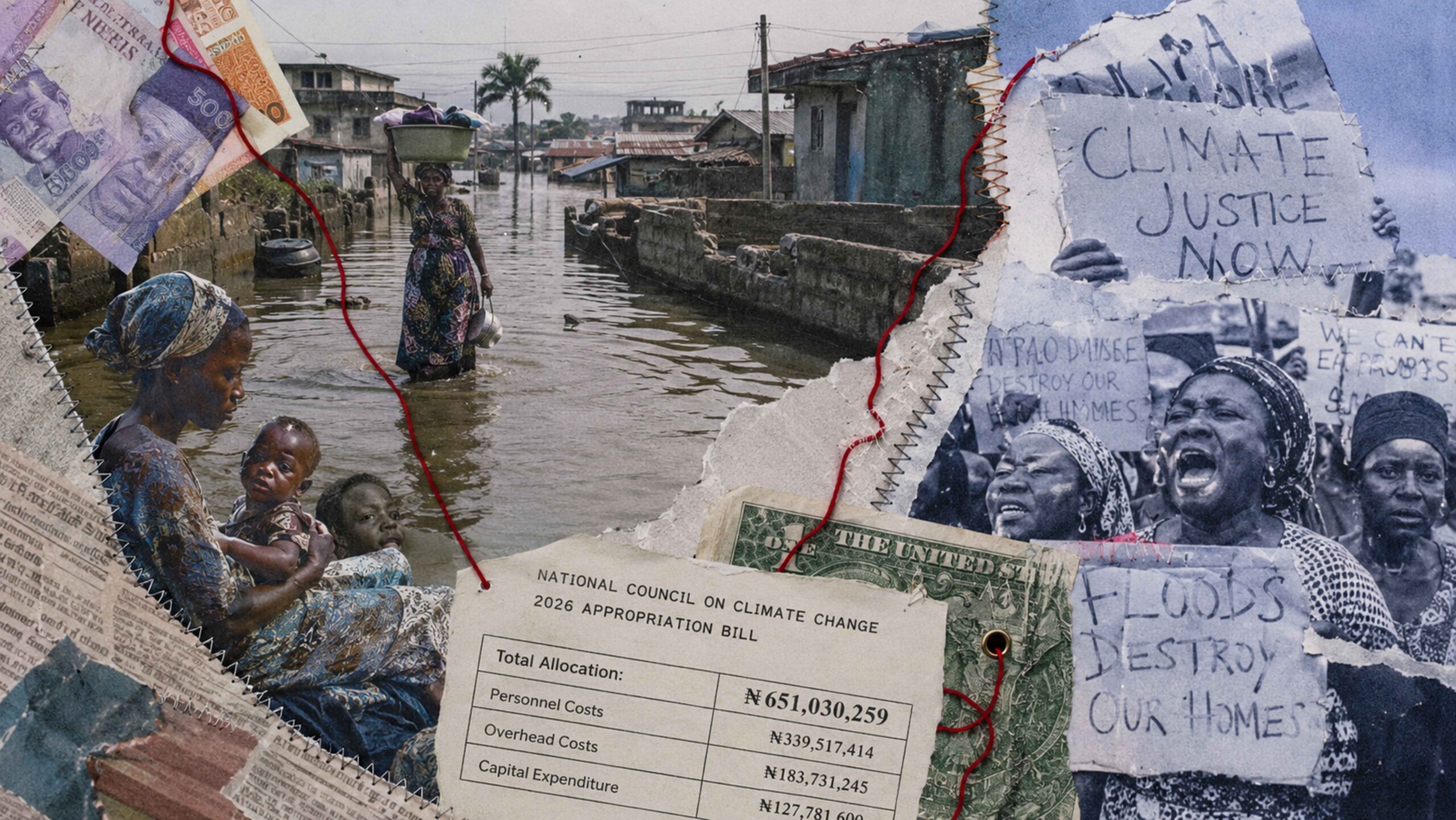
The Nigerian government has allocated just N651.03 million to the National Council on Climate Change (NCCC) in the 2026 Appropriation Act, raising questions about whether the country is investing enough in the agency responsible for coordinating climate action as floods, drought and food insecurity increasingly threaten millions of Nigerians, especially women and girls.
An analysis of the 2026 budget by Gender Rights shows the council received N151.03 million for personnel, N200 million for overheads and N300 million for capital expenditure, bringing its total allocation to N651.03 million.
Established under the Climate Change Act, 2021, the NCCC is mandated to coordinate Nigeria’s climate policies, oversee implementation of the country’s Nationally Determined Contributions (NDCs), mobilise climate finance, develop carbon markets and guide adaptation and mitigation efforts.
The allocation comes as climate disasters become more frequent across Nigeria, with floods, drought, desertification and coastal erosion destroying homes, farms and livelihoods while worsening food insecurity.
While climate change affects 78.7 per cent of households in Nigeria, evidence shows that 55.3 per cent of women reported experiencing intimate partner violence, worsened by economic stress, and 65.3 per cent of girls dropped out of school due to climate-related hardships and conflict, according to ActionAid International.
The consequences are already visible across the country. In May 2025, floods in Mokwa, Niger State killed more than 153 people, displaced hundreds and destroyed over 10,000 hectares of farmland, according to the UN Office for the Coordination of Humanitarian Affairs (OCHA), noting that among those worst affected were more than 1,600 children and nearly 800 pregnant and breastfeeding women who lost homes, food supplies and access to healthcare.
A month later, flooding in Borno State affected 19,290 people, including 6,464 women and 9,139 children, while 4,667 homes were damaged.
Across Adamawa, Borno and Yobe, OCHA said floods during the 2025 lean season affected 64,649 people, displaced 13,847 residents, killed 53 people and submerged 8,716 hectares of farmland across 190 communities, worsening hunger in regions already grappling with conflict.
According to HumAngle, the Executive Director of the Concern for Climate Change for the Community Initiative (FOURCi), Bala Gabriel, said climate change affects women more severely in the Northeast because it compounds the impacts of the Boko Haram conflict.
Experts have said that in many rural communities, women are primarily responsible for food production, fetching water, collecting firewood and caring for children and elderly relatives, but when floods destroy farms, drought dries up water sources or erosion forces communities to relocate, these responsibilities become more difficult and time-consuming.
According to UN Women, women constitute a large share of the world’s agricultural workforce but often have less access than men to land ownership, agricultural inputs, credit and climate-resilient technologies.
The Federal Ministry of Women Affairs reported in 2023 that only one in five landowners in Nigeria is female, noting that the country’s Gross Domestic Product (GDP) could increase by $229 billion over a decade if women participated in the workforce at the same level as men. Although Nigeria’s constitution, under the 1978 Land Use Act, accords equal rights to men and women to acquire and own assets, the reality remains unchanged for women.
As climate shocks intensify, these inequalities deepen, reducing women’s incomes and household food security.
The NCCC is expected to coordinate Nigeria’s climate response across dozens of ministries, implement adaptation policies, mobilise international climate finance, oversee carbon market development and monitor progress towards national climate commitments, yet its entire 2026 allocation of N651.03 million is smaller than the cost of several individual capital projects approved in some Ministries and departments in the federal budget.
As climate disasters become more frequent and severe, the effectiveness of Nigeria’s response will depend not only on policy commitments but also on whether the country’s climate institutions are adequately funded to protect the communities bearing the heaviest burden, particularly women and girls.